

Hey there! As an Outdoor Compact Substation supplier, I often get asked about how to calculate the power loss of these substations. It's a crucial topic, especially for those looking to optimize energy efficiency and cut costs. So, let's dive right in and break down the process step by step.
Understanding the Basics of Power Loss
First off, we need to understand what power loss is. In an outdoor compact substation, power loss mainly occurs in two parts: the transformer and the conductors. The power loss in a substation can be divided into two types: no - load loss and load loss.
No - load loss, also known as iron loss, happens even when the transformer isn't carrying any load. It's caused by the magnetic field in the transformer core. This loss is constant and doesn't change with the load on the substation.
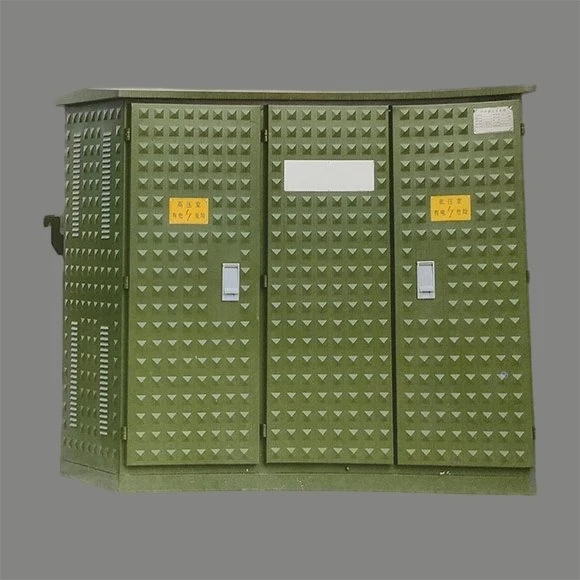

On the other hand, load loss, also called copper loss, occurs due to the resistance of the conductors in the transformer and other components. This loss varies with the load on the substation. The higher the load, the greater the load loss.
Calculating No - Load Loss
Calculating no - load loss is relatively straightforward. The no - load loss of a transformer is usually provided by the manufacturer. It's measured in kilowatts (kW). You can find this value in the transformer's datasheet.
Let's say you have a transformer with a no - load loss of 2 kW. This means that even when there's no load on the substation, the transformer is still consuming 2 kW of power. To calculate the energy loss over a certain period, you can use the following formula:
Energy loss (kWh) = No - load loss (kW) × Time (h)
For example, if the substation is running for 24 hours a day, the daily energy loss due to no - load loss would be:
Energy loss = 2 kW × 24 h = 48 kWh
Calculating Load Loss
Calculating load loss is a bit more complicated as it depends on the load current. The load loss formula is based on the square of the load current and the resistance of the conductors.
The formula for load loss is:
$P_{load}=I^{2}R$
where $P_{load}$ is the load loss in watts (W), $I$ is the load current in amperes (A), and $R$ is the resistance of the conductors in ohms (Ω).
To calculate the load current, you can use the following formula:
$I=\frac{P}{\sqrt{3}V\cos\varphi}$
where $P$ is the load power in watts (W), $V$ is the line voltage in volts (V), and $\cos\varphi$ is the power factor.
Let's take an example. Suppose you have a substation with a load power of 100 kW, a line voltage of 10 kV, and a power factor of 0.9. First, we calculate the load current:
$I=\frac{100\times10^{3}}{\sqrt{3}\times10\times10^{3}\times0.9}\approx6.35 A$
If the resistance of the conductors is 0.1 Ω, then the load loss is:
$P_{load}=I^{2}R=(6.35)^{2}\times0.1\approx4.03 W$
Total Power Loss
To find the total power loss of the outdoor compact substation, you simply add the no - load loss and the load loss.
$P_{total}=P_{no - load}+P_{load}$
Using the values from our previous examples, if the no - load loss is 2000 W and the load loss is 4.03 W, then the total power loss is:
$P_{total}=2000 + 4.03=2004.03 W$
Factors Affecting Power Loss
There are several factors that can affect the power loss of an outdoor compact substation.
Temperature: Higher temperatures increase the resistance of the conductors, which in turn increases the load loss.
Load Variation: As mentioned earlier, load loss varies with the load. A higher load means more power loss.
Transformer Efficiency: The efficiency of the transformer plays a big role. A more efficient transformer will have lower no - load and load losses.
Importance of Calculating Power Loss
Calculating power loss is important for several reasons. Firstly, it helps in determining the energy efficiency of the substation. By reducing power loss, you can save on energy costs. Secondly, it helps in sizing the substation correctly. If you underestimate the power loss, the substation may overheat and fail.
Our Outdoor Compact Substations
At our company, we offer a wide range of Outdoor Compact Substation that are designed to be energy - efficient. Our substations are equipped with high - quality transformers that have low no - load and load losses.
We also have other types of substations such as PV Step - up Substation, Underground Pad Mounted Transformer, Wind Power Combined Transformer, and Wind Power Compact Substation. These substations are designed to meet the specific needs of different applications.
Contact Us for Purchase
If you're interested in our outdoor compact substations or any of our other products, we'd love to hear from you. Whether you need to calculate the power loss for your specific application or have any other questions, our team of experts is here to help. Contact us to start a purchase negotiation and find the best substation solution for your needs.
References
- Electrical Power Systems by J. R. Lucas
- Transformer Engineering: Design, Technology, and Diagnostics by G. K. Dubey